Why Generator Sound Levels Matter
When selecting a diesel generator for your project, one of the most critical — yet frequently overlooked — specifications is the noise level, measured in decibels (dB or dBA). Generator noise can have significant implications for regulatory compliance, worker health, community relations, and the overall success of your installation. Whether you are powering a construction site in a residential area, a telecommunications tower in a national park, or a mining camp in a remote region, understanding generator sound levels is essential for making an informed purchasing decision.
This comprehensive guide will walk you through everything you need to know about generator noise levels, industry standards, comparison data, and practical tips for selecting the right silent generator for your specific application.
Understanding dBA: The Standard for Measuring Generator Noise
Generator noise levels are typically expressed in dBA (A-weighted decibels), which is a standardized measurement that accounts for the human ear’s sensitivity to different frequencies. Unlike raw decibel (dB) measurements, dBA filtering emphasizes the mid-range frequencies where human hearing is most sensitive, providing a more accurate representation of the perceived loudness.
It is important to note that the decibel scale is logarithmic, not linear. This means that every increase of 10 dBA represents a perceived doubling of loudness. For example:
- 60 dBA — Normal conversation at 1 meter
- 70 dBA — Vacuum cleaner at 1 meter
- 80 dBA — Busy street traffic
- 90 dBA — Lawn mower at close range
- 100 dBA — Power tools at close range
- 110 dBA — Rock concert (front rows)
Generator noise is typically measured at a distance of 7 meters (approximately 23 feet) from the unit, which is the industry-standard reference distance established by ISO 8528-10. When comparing specifications from different manufacturers, always ensure that the measurements are taken at the same distance for an accurate comparison.
Generator Noise Comparison by Type
Diesel generators are broadly categorized into three types based on their noise attenuation features. The table below provides a comprehensive comparison of typical noise levels for each type:
| Generator Type | Noise Level (dBA at 7m) | Typical Application | Enclosure Type | Relative Cost |
|---|---|---|---|---|
| Open-Frame (Canopy-Free) | 95 – 110 dBA | Industrial sites, remote mining, oil & gas | None / Base frame only | Lowest |
| Standard Canopy (Weatherproof) | 80 – 90 dBA | Construction sites, agriculture, backup power | Basic steel canopy with minimal insulation | Low–Medium |
| Silent / Super Silent | 60 – 75 dBA | Residential areas, events, telecom towers | Insulated canopy with acoustic panels | Medium–High |
| Ultra-Silent | 50 – 60 dBA | Hospitals, hotels, recording studios | Heavy-duty acoustic enclosure with multi-layer insulation | Highest |
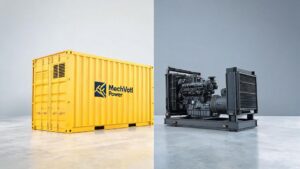
| Containerized | 70 – 85 dBA | Data centers, large-scale mining, military | Modified ISO shipping container | High |
Detailed Breakdown by Generator Type
1. Open-Frame Generators (95–110 dBA)
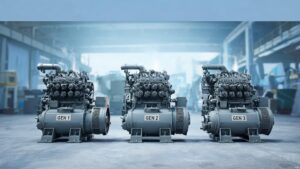
Open-frame generators, also known as open-set or canopy-free generators, are the most basic configuration. The engine, alternator, and control panel are mounted on a base frame without any acoustic enclosure. These units produce the highest noise levels and are typically deployed in environments where noise regulations are minimal or nonexistent, such as remote mining operations, oil fields, and heavy industrial facilities.
2. Standard Canopy Generators (80–90 dBA)
Standard canopy generators feature a basic weatherproof steel enclosure that provides some degree of noise reduction, primarily by deflecting engine noise upward and away from the immediate surroundings. While these units offer moderate noise attenuation, they are generally not suitable for noise-sensitive environments. They are commonly used on construction sites, agricultural operations, and as backup power systems in commercial buildings.
3. Silent and Super Silent Generators (60–75 dBA)
Silent generators, also referred to as sound-attenuated or super silent generators, are equipped with purpose-built acoustic enclosures designed to minimize noise emission. These enclosures incorporate multiple layers of sound-absorbing materials, specialized exhaust silencers, and vibration isolation mounts. MechVolt Power’s super silent generator series, for example, achieves noise levels as low as 58 dBA at 7 meters — quieter than a typical office environment.
4. Ultra-Silent Generators (50–60 dBA)
Ultra-silent generators represent the pinnacle of noise reduction technology. These units employ heavy-duty acoustic enclosures with multi-layer composite insulation, advanced exhaust muffler systems, and acoustic louvers for airflow management. They are designed for the most noise-critical applications, including hospitals, hotels, data centers, and outdoor event venues.
5. Containerized Generators (70–85 dBA)
Containerized generators are housed in modified ISO shipping containers, which provide excellent structural protection and moderate noise attenuation. The container structure naturally provides some sound insulation, and additional acoustic treatment can be applied to the interior walls, ceiling, and doors. These units are ideal for large-scale power applications where durability, security, and mobility are paramount.
How Noise Reduction Technology Works in Silent Generators
The noise produced by a diesel generator comes from four primary sources: engine mechanical noise, exhaust noise, cooling fan noise, and vibration-induced noise. Effective silent generator design addresses each of these sources through a combination of engineering techniques:
Acoustic Enclosure Design
- Multi-layer composite panels: The enclosure walls typically consist of an outer steel skin, a layer of high-density rock wool or mineral wool insulation (50–100 mm thick), and an inner perforated steel liner. This sandwich construction effectively absorbs mid-to-high-frequency noise while reflecting low-frequency sound waves.
- Acoustic louvers: Specially designed ventilation louvers with angled baffles allow cooling air to flow through the enclosure while preventing sound waves from escaping. The baffle geometry is optimized using computational acoustic modeling.
- Vibration isolation: The generator set is mounted on heavy-duty anti-vibration mounts (typically rubber or spring isolators) that decouple mechanical vibrations from the enclosure structure, preventing structure-borne noise transmission.
Exhaust Silencing Systems
- Resonator silencers: Multi-chamber exhaust silencers use expansion chambers and perforated tubes to cancel specific frequency components of exhaust noise, reducing low-frequency rumble.
- Absorptive silencers: Packed with sound-absorbing material, these silencers target mid-to-high-frequency exhaust noise, complementing the resonator stage.
- Critical-grade silencers: For the most demanding applications, critical-grade silencers combine both resonator and absorptive principles in a single unit, achieving noise reductions of 30–40 dBA or more.
Choosing the Right Noise Level for Your Application
Selecting the appropriate generator noise level depends on several factors, including local noise regulations, proximity to noise-sensitive receivers, operating schedule, and budget constraints. Here are practical guidelines for common application scenarios:
| Application Scenario | Recommended Noise Level | Generator Type | Key Considerations |
|---|---|---|---|
| Residential area (daytime use) | ≤ 70 dBA | Silent / Super Silent | Check local municipal noise ordinances |
| Residential area (nighttime use) | ≤ 55 dBA | Ultra-Silent | Stricter nighttime limits typically apply |
| Outdoor events & weddings | ≤ 65 dBA | Silent / Ultra-Silent | Background noise must not interfere with activities |
| Hospital & healthcare | ≤ 55 dBA | Ultra-Silent | Patient comfort and recovery requirements |
| Telecom tower (rural) | ≤ 65 dBA | Silent | May be located near residential areas |
| Construction site | ≤ 85 dBA | Standard Canopy | Combined with other site noise sources |
| Remote mining / oil field | No strict limit | Open-Frame / Containerized | Prioritize reliability and fuel efficiency |
| Data center | ≤ 70 dBA | Silent / Containerized | Must not interfere with cooling systems |
| Military / defense | ≤ 60 dBA | Ultra-Silent / Containerized | Operational security requirements |
Practical Tips for Minimizing Generator Noise on Site
Even after selecting the right generator type, additional measures can further reduce noise impact at your installation site:
- Positioning: Place the generator as far as practical from noise-sensitive areas. Every doubling of distance from the source reduces noise by approximately 6 dBA.
- Barriers: Solid walls, earth berms, or purpose-built acoustic barriers between the generator and receivers can provide an additional 10–15 dBA of noise reduction.
- Exhaust routing: Route the exhaust pipe vertically upward and away from occupied areas. Avoid directing exhaust outlets toward buildings or property boundaries.
- Regular maintenance: Worn exhaust systems, loose panels, and degraded vibration mounts can increase noise levels by 5–10 dBA over time. Schedule regular inspections and maintenance.
- Load management: Operating a generator at 75–100% of its rated load typically produces less noise than running at very low loads, where combustion irregularities can increase mechanical noise.
Conclusion
Understanding generator sound levels is crucial for selecting the right power solution for your specific needs. By considering factors such as dBA ratings, generator types, noise reduction technologies, and application-specific requirements, you can make an informed decision that ensures regulatory compliance, minimizes environmental impact, and maintains good relationships with surrounding communities.
MechVolt Power offers a comprehensive range of silent and super silent diesel generators with noise levels from 58 dBA to 75 dBA, available in power ratings from 30 kVA to 1000 kVA. Our engineering team can help you select the optimal generator configuration for your project, including custom acoustic solutions for the most demanding noise requirements. Contact us today at mechvolt.com or email info@mechvolt.com for a free consultation.