Choosing the right diesel generator size is one of the most critical decisions you will make for your project. Undersize your generator, and it will trip under load, shorten equipment lifespan, or fail exactly when you need it most. Oversize it, and you will pay more upfront, burn more fuel, and accelerate engine wear from wet stacking. In this guide, we walk you through the complete process of diesel generator sizing — from load analysis to final selection — so you can make an informed decision with confidence.
Why Generator Sizing Matters
A diesel generator is not a “bigger is better” purchase. It is a precision-engineered system designed to operate within a specific load range. Here is what happens when you get the size wrong:
Undersizing: The Costly Shortcut
When a generator is too small for the connected load, it cannot maintain rated voltage and frequency. The engine bogs down, the alternator overheats, and protective breakers trip. In the best case, you experience nuisance outages. In the worst case, you damage both the generator and the equipment it is supposed to protect — motors burn out, electronics fail, and downtime costs multiply.
Oversizing: The Hidden Penalty
An oversized generator is less obvious but equally problematic. Diesel engines are designed to run at 30-70% of their rated load for optimal efficiency. When a generator runs consistently below 30% load, unburned fuel and carbon accumulate in the exhaust system — a condition called “wet stacking.” This reduces engine efficiency, increases maintenance costs, and shortens engine life. You also pay more for the generator, the installation, and the fuel than you need to.
Step 1: Conduct a Complete Load Analysis
The foundation of proper generator sizing is a thorough load analysis. You need to identify every piece of equipment the generator will power, then calculate the total power requirement.
List Every Load
Start by listing every electrical device the generator will support. For each item, record:
- Device name and type (motor, lighting, heating, electronics)
- Rated power in kW or kVA
- Power factor (PF)
- Voltage and phase (single-phase or three-phase)
- Starting method (direct-on-line, star-delta, VFD, soft starter)
- Running sequence (continuous, intermittent, standby)
Understand the Difference Between kW and kVA
This is where many buyers go wrong. kW (kilowatts) is real power — the actual work performed. kVA (kilovolt-amperes) is apparent power — the total power drawn from the system. The relationship between them is:
kW = kVA × Power Factor
Most generators are rated in kVA at a power factor of 0.8. So a 100 kVA generator at 0.8 PF delivers 80 kW of real power. If your loads total 80 kW at 0.8 PF, you need at least 100 kVA of generator capacity — before applying any safety margins.
Step 2: Calculate Starting (Inrush) Currents
This is the step that catches most first-time buyers off guard. Electric motors — especially induction motors driving pumps, compressors, and fans — draw far more current during startup than during normal running. This is called “inrush current” or “starting current.”
Typical Starting Current Multipliers
| Starting Method | Typical Inrush (× FLC) | Best For |
|---|---|---|
| Direct-on-Line (DOL) | 6-8 × Full Load Current | Small motors under 5.5 kW |
| Star-Delta Starter | 2-3 × Full Load Current | Medium motors 5.5-75 kW |
| Soft Starter | 2-4 × Full Load Current | Reduced mechanical stress |
| VFD (Variable Frequency Drive) | 1-1.5 × Full Load Current | Speed control + lowest inrush |
For example, a 30 kW motor with DOL starting may require up to 240 kW of instantaneous power during the first few seconds of startup. Your generator must be able to deliver this surge without dropping voltage or frequency beyond acceptable limits.
The Sequential Starting Strategy
You rarely start all motors simultaneously. By sequencing motor starts — starting the largest motor first, then progressively smaller ones — you can significantly reduce the peak demand on the generator. A well-designed sequential start can reduce the required generator size by 20-30% compared to simultaneous starting.
Step 3: Account for Non-Linear Loads
Modern facilities are full of non-linear loads — UPS systems, variable frequency drives, computers, LED lighting with electronic drivers, and telecommunications equipment. These loads draw current in short pulses rather than smooth sine waves, producing harmonic distortion that heats the generator alternator and can cause voltage instability.
For facilities where non-linear loads exceed 20% of total load, apply a derating factor of 10-15% to the generator’s rated output. Alternatively, specify a generator with a permanently connected damper winding (sub-transient reactance of 12% or lower) to better handle harmonic loads.
Step 4: Apply Environmental Derating Factors
Generator nameplate ratings are based on standard reference conditions: 25°C (77°F) ambient temperature, 100 m (328 ft) altitude, and 30% relative humidity. If your installation site deviates from these conditions, the generator produces less power than its nameplate suggests.
Standard Derating Guidelines
| Condition | Derating Factor |
|---|---|
| Each 10°C above 25°C ambient | 3-5% power reduction |
| Each 300 m above 100 m altitude | 3-5% power reduction |
| High humidity (above 60% at 40°C+) | 1-2% additional reduction |
For a project in Dubai where the ambient temperature reaches 50°C and the site is at sea level, a 500 kVA generator may only deliver approximately 420-440 kVA under peak summer conditions. Always specify your site conditions to the generator supplier so they can recommend the correct frame size for your environment.
Step 5: Add the Safety Margin
After calculating the total running load, the largest starting surge, environmental derating, and non-linear load factors, add a safety margin of 15-20%. This margin accounts for:
- Future load additions or expansion plans
- Measurement errors in your load analysis
- Engine performance degradation over time
- Unexpected simultaneous loads
However, do not exceed a 25% margin — beyond that, the generator will run at persistently low load, leading to wet stacking and engine damage.
Step 6: Select Standby vs Prime Power Rating
Generators are rated for different duty cycles. Choosing the wrong rating leads to premature failure.
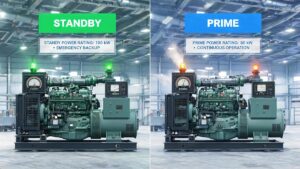
Standby Power Rating (ESP)
Designed for emergency backup power during utility outages. The generator runs at variable load for up to 200 hours per year, with no more than 25 hours of continuous operation at any single time. Typical overload allowance is 10% for 1 hour in any 12-hour period. Standby ratings are approximately 10% higher than equivalent prime ratings.
Prime Power Rating (PRP)
Designed for continuous operation at variable load for an unlimited number of hours per year. The average load should not exceed 70% of the prime rating over any 24-hour period. Prime-rated generators are built heavier, with upgraded cooling and lubrication systems.
Continuous Power Rating (COP)
Designed for non-variable, constant load for unlimited hours per year at 100% of the rating. Used in applications like grid parallel operation or base-load power generation.
If you are sizing a generator for a factory that will run as the primary power source for 12+ hours per day, choose a prime power rating. If the generator only runs during utility outages, a standby rating is sufficient and more cost-effective.
Real-World Sizing Example
Let us walk through a practical example. A small manufacturing facility needs a standby generator with the following loads:
| Load | Running Power (kW) | Power Factor | Starting Method |
|---|---|---|---|
| Air compressor (55 kW motor) | 55 | 0.85 | Star-Delta (2.5× inrush) |
| Hydraulic pump (22 kW motor) | 22 | 0.85 | DOL (6× inrush) |
| Lighting and outlets | 15 | 0.9 | N/A |
| Welding machine | 18 | 0.7 | N/A |
Total running load: 110 kW
Largest starting surge: Air compressor starts first: 55 × 2.5 = 137.5 kW peak demand
At 0.8 PF: 110 kW ÷ 0.8 = 137.5 kVA running, with peak surge of approximately 172 kVA
Environmental derating (40°C site, 200 m altitude): 5% reduction
With 20% safety margin: 172 kVA × 1.05 ÷ 0.95 × 1.20 ≈ 228 kVA
Recommended generator: 250 kVA standby rated (next standard size above 228 kVA)
This generator will run at approximately 55% load during normal operation — right in the optimal efficiency band for a diesel engine.
Common Sizing Mistakes to Avoid
1. Ignoring Motor Starting Currents
This is the number one cause of generator undersizing. Always calculate the worst-case starting surge and verify the generator can handle it.
2. Using Nameplate kW Without Power Factor
Motor nameplates list rated power in kW at the shaft. To get the electrical input power, divide by the motor efficiency and power factor. A 30 kW motor at 90% efficiency and 0.85 PF actually draws approximately 39 kVA from the generator.
3. Forgetting About Future Expansion
If you plan to add equipment in the next 2-3 years, factor it in now. Upgrading a generator later is far more expensive than buying a slightly larger unit upfront.
4. Not Considering Load Diversity
Not all equipment runs simultaneously. A load diversity factor accounts for this. If only 70% of your loads ever operate at the same time, you can reduce the sizing calculation accordingly — but be conservative.
Tools and Resources for Accurate Sizing
While manual calculations give you a solid understanding, professional sizing software can handle complex scenarios with dozens of loads, multiple starting sequences, and dynamic load profiles. At MechVolt Power, our engineering team uses specialized sizing software to model your entire load profile and recommend the optimal generator configuration.
We also provide on-site load surveys, power quality analysis, and custom sizing reports as part of our pre-sales engineering support — at no cost to qualified projects.
Conclusion
Proper diesel generator sizing is a multi-step process that requires careful load analysis, an understanding of motor starting characteristics, environmental considerations, and the right duty rating. Getting it right means reliable power, lower operating costs, and a longer equipment life. Getting it wrong means costly downtime, damaged equipment, and ongoing frustration.
The investment in a thorough sizing analysis pays for itself many times over. If you are unsure about any step in this process, reach out to a qualified generator supplier who can perform the calculations for you and provide a documented sizing report.
Need help sizing your generator? Contact the MechVolt Power engineering team for a free sizing analysis and equipment recommendation tailored to your project requirements.
Related reading: Prime vs Standby Power Rating: What’s the Difference | Diesel Generator Fuel Consumption: How to Calculate Running Costs