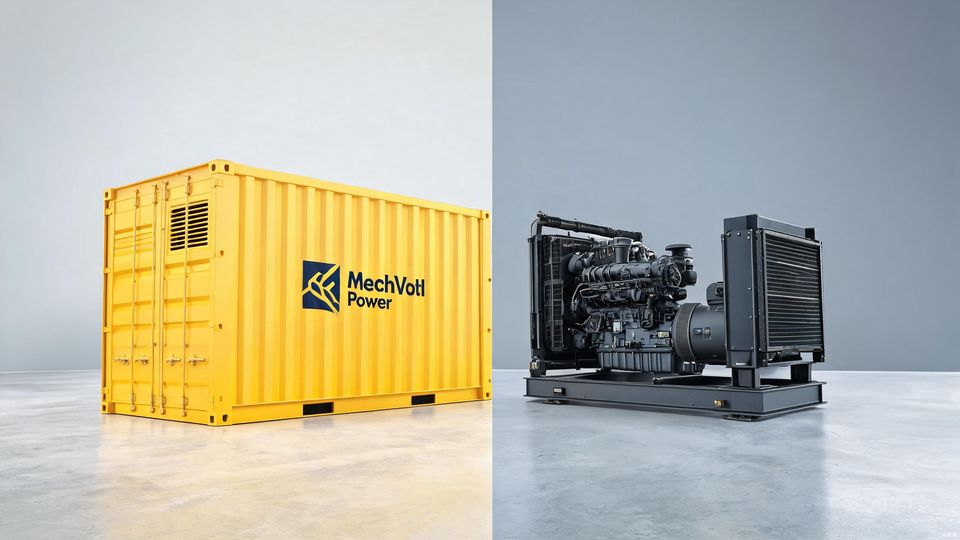
When you are evaluating a diesel generator set for your project, one of the first decisions you will face is the enclosure type. Should you choose a containerized generator or an open-frame generator? At MechVolt Power, we manufacture and ship both configurations worldwide, and the right choice depends heavily on your site conditions, budget, noise requirements, and long-term mobility needs.
In this guide, we will compare container and open-frame generator sets across six critical dimensions: cost, durability, noise control, mobility, installation complexity, and maintenance access. By the end, you will have a clear framework for making the right decision.
What Is a Container Generator Set?
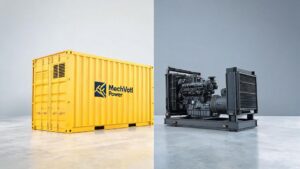
A container generator set is housed inside a modified shipping container, typically a 20-foot or 40-foot ISO container. The container is reinforced, soundproofed, and fitted with ventilation, fuel tanks, control panels, and exhaust systems. These units are often called “containerized,” “soundproof canopy,” or “silent container” generators.
Key Characteristics:
- Fully enclosed structure with lockable doors
- Integrated sound attenuation (typically 75-85 dB at 1 meter)
- Weatherproof and dustproof protection
- Built-in fuel tank options (up to several thousand liters)
- Easy to transport by truck, ship, or rail
What Is an Open-Frame Generator Set?
An open-frame generator set consists of the engine, alternator, radiator, and control panel mounted on a structural steel base frame. There is no enclosing canopy or container. These are sometimes called “open-type” or “skid-mounted” generators.
Key Characteristics:
- Exposed components for maximum cooling and easy access
- Significantly lower cost than containerized equivalents
- Higher noise levels (typically 95-110 dB at 1 meter)
- Requires a dedicated engine room or shelter for outdoor use
- Compact footprint and lighter weight
Head-to-Head Comparison
| Factor | Container Generator | Open-Frame Generator |
|---|---|---|
| Initial Cost | 15% to 40% higher | Lower base cost |
| Noise Level | 75-85 dB at 1 meter | 95-110 dB at 1 meter |
| Weather Protection | Fully weatherproof | Requires shelter or engine room |
| Transport & Mobility | ISO container standard; easy to move | Requires crane or flatbed; less portable |
| Installation | Plug-and-play; minimal civil work | Requires foundation, shelter, and ventilation design |
| Maintenance Access | Good; large doors on both sides | Excellent; fully exposed components |
| Fuel Tank Integration | Often integrated (8-24 hour runtime) | Requires external fuel tank |
| Security | Lockable; tamper-resistant | Vulnerable to theft and vandalism |
When to Choose a Container Generator
Based on our project experience, container generators are the better choice in the following scenarios:
1. Remote or Harsh Environments
If your project is in a desert, coastal, or tropical region with high humidity, salt, dust, or extreme temperatures, the sealed container enclosure protects critical components from environmental damage. We have supplied containerized units to mining operations in West Africa and coastal resorts in Southeast Asia where corrosion and dust are serious concerns.
2. Noise-Sensitive Locations
Hospitals, schools, residential areas, and urban commercial zones typically have strict noise ordinances. A container generator with proper sound attenuation can meet 75 dB or lower requirements without additional infrastructure. One of our clients, a hospital in Nairobi, installed a 500 kVA container set just 10 meters from the main building and achieved full compliance with local noise regulations.
3. Temporary or Mobile Power Needs
Construction sites, event venues, and disaster relief operations need power that can be relocated quickly. Container generators are designed for exactly this. They can be lifted by crane, transported by standard trucks, and redeployed with minimal downtime.
4. Limited On-Site Infrastructure
If your site does not have an existing engine room or the budget to build one, a container generator offers a turnkey solution. The unit arrives pre-tested and ready to connect to your load.
When to Choose an Open-Frame Generator
Open-frame generators excel in different conditions:
1. Permanent Installations with Existing Infrastructure
If you already have a dedicated generator room with proper ventilation, exhaust ducting, and acoustic treatment, an open-frame unit is the most cost-effective choice. Many industrial facilities and data centers prefer this approach because it centralizes maintenance and maximizes equipment life through controlled environments.
2. Tight Budget Constraints
The cost difference is significant. For a 500 kVA set, the container enclosure can add $8,000 to $15,000 to the total price. If your project has strict budget limits and you can provide basic shelter, the open-frame option frees up capital for other priorities.
3. Maximum Cooling Efficiency
In hot climates, engine cooling is critical. Open-frame generators have unrestricted airflow around the radiator and engine block. For a 1,000 kVA unit running at full load in 45°C ambient temperature, the improved cooling can reduce the risk of overheating shutdowns.
4. Frequent Maintenance Requirements
If your operational plan calls for intensive maintenance schedules, open-frame units allow technicians to access every component without opening doors or working inside an enclosed space. This can reduce routine service time by 20% to 30%.
Real-World Cost Comparison
Here is a simplified total cost comparison for a 500 kVA diesel generator set over a five-year period, assuming 2,000 operating hours per year:
| Cost Component | Container Generator | Open-Frame Generator |
|---|---|---|
| Initial equipment cost | $42,000 | $34,000 |
| Transport to site | $1,500 | $2,500 |
| On-site installation | $2,000 | $6,000 |
| Acoustic shelter (if needed) | Included | $5,000 |
| 5-year maintenance | $9,500 | $8,500 |
| 5-year total | $55,000 | $56,000 |
Note: Figures are illustrative based on typical project data in emerging markets. Actual costs vary by region, shipping distance, and local labor rates.
As the table shows, the total cost of ownership often converges. The higher upfront cost of the container generator is partially offset by lower installation and shelter expenses.
Hybrid and Custom Options
At MechVolt Power, we also offer hybrid configurations for clients with specific requirements:
- Canopy generators: A weatherproof steel canopy with partial sound attenuation, offering a middle ground between open-frame and full container enclosures.
- Trailer-mounted open-frame units: For clients who need mobility without the full container cost.
- Custom container modifications: Side doors, skylights, remote monitoring integration, and oversized fuel tanks for specific project needs.
Final Recommendations
| Your Situation | Recommended Choice |
|---|---|
| Remote site, harsh environment, no engine room | Container generator |
| Urban area with noise restrictions | Container generator |
| Temporary power, frequent relocation | Container generator |
| Existing generator room with ventilation | Open-frame generator |
| Tightest possible budget | Open-frame generator + basic shelter |
| Maximum cooling in extreme heat | Open-frame generator in ventilated room |
Talk to Our Engineers
The container versus open-frame decision is not just about the generator itself. It affects your site layout, civil works budget, noise compliance, maintenance schedule, and long-term operating costs. At MechVolt Power, we help clients evaluate these factors before recommending a configuration.
If you are comparing quotations from multiple suppliers, make sure you are comparing equivalent specifications. A container generator from one supplier may include an 8-hour fuel tank, while another includes only 4 hours. The acoustic rating may differ by 10 dB or more. The container steel thickness and corrosion protection standard also vary.
Not sure which configuration fits your project? Contact our engineering team with your site details, noise limits, and mobility requirements. We will recommend the most suitable setup and provide a detailed technical and commercial proposal within 24 hours.
Related reading: Cummins vs Perkins vs Weichai: A Fair Comparison of Popular Generator Engines | How to Choose the Right kVA for Your Factory