
Why Power Rating Is the First Question We Ask
At MechVolt Power, when a buyer reaches out for a generator quote, our first question is never “what size?” — it’s “how will you use it?” The answer determines everything: engine spec, cooling system, alternator sizing, and price.
We’ve seen buyers request a 500kVA standby-rated unit for a mine that runs 20 hours a day. That’s a recipe for engine failure within 6 months. On the flip side, we’ve seen hospitals overspend on prime-rated units for emergency backup that runs 50 hours a year.
Understanding the difference between prime, standby, and continuous power ratings isn’t just technical trivia — it’s the difference between a generator that lasts 15 years and one that needs a rebuild in 2.
The Three Power Ratings Explained
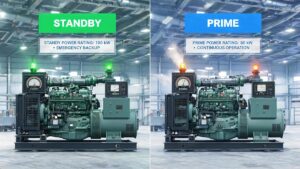
Diesel generator engines are rated based on how many hours per year they can run at a given load. Here’s what each rating actually means in practice:
Prime Power (PRP)
Prime power is for applications where the generator is the main source of power — no utility grid available, or the grid is too unreliable to count on.
- Run time: Unlimited hours per year
- Load: Variable — can handle average load of 70% of PRP rating over 24 hours
- Overload: 10% overload allowed for 1 hour in every 12 hours
- Typical use: Mining camps, construction sites, remote factories, off-grid operations
What this means: if you buy a 500kVA prime-rated generator, you can run it 24/7 at an average load of up to 350kVA. If you hit 500kVA for an hour, that’s fine — just don’t do it all day.
Standby Power (ESP)
Standby power is for emergency backup only — when the main power fails and you need the generator to kick in.
- Run time: Maximum 200 hours per year (some manufacturers allow 500 hours)
- Load: Fixed at 100% of ESP rating during outage
- Overload: None — running above ESP rating voids warranty
- Typical use: Hospitals, data centers, office buildings, telecom towers
Standby-rated generators are cheaper because the engine isn’t built for continuous thermal cycling. The cooling system, turbocharger, and pistons are all specced for intermittent use.
Continuous Power (COP)
Continuous power is the most conservative rating — for applications where the generator runs at a constant load, 24/7, 365 days a year.
- Run time: Unlimited hours per year
- Load: Fixed at 100% of COP rating — no overload allowed
- Overload: None
- Typical use: Base-load power plants, remote pumping stations, continuous industrial processes
Continuous-rated engines have heavier-duty components: bigger cooling systems, reinforced pistons, and often slower RPM (1000 or 750 RPM instead of 1500 RPM) for longer lifespan.
Quick Comparison Table
| Feature | Prime (PRP) | Standby (ESP) | Continuous (COP) |
|---|---|---|---|
| Max annual hours | Unlimited | 200-500 | Unlimited |
| Average load limit | 70% of rating | N/A (100% during outage) | 100% of rating |
| Overload capacity | 10% for 1hr/12hrs | None | None |
| Engine spec | Medium-duty | Light-duty | Heavy-duty |
| Price (same kVA) | Medium | Lowest | Highest |
| Typical lifespan | 15,000-20,000 hrs | 8,000-12,000 hrs | 25,000-30,000 hrs |
Real-World Examples from Our Projects
Example 1: The Mining Camp That Needed Prime Power
A client in West Africa bought a 300kVA standby-rated generator for their gold mining camp because it was 15% cheaper. They ran it 18 hours a day at 75% load.
Within 8 months, the engine had severe piston scoring and the turbocharger failed. The repair bill was $18,000 — more than the price difference between standby and prime ratings. We replaced it with a 350kVA prime-rated unit. Three years later, it’s still running strong with only routine maintenance.
Example 2: The Hospital That Overspent
A hospital in Southeast Asia requested a 1000kVA prime-rated generator for emergency backup. Their actual load was 400kVA, and the generator had run 120 hours in 3 years.
They spent $40,000 more than necessary. A 500kVA standby-rated unit would have handled their load with room to spare, at significantly lower cost. The prime-rated unit was overkill for their use case.
How to Choose the Right Rating for Your Project
Here’s the decision framework we use with our clients:
Step 1: Count Your Annual Run Hours
- Under 200 hours/year: Standby is probably fine
- 200-500 hours/year: Consider prime if load is variable; standby if load is consistent
- Over 500 hours/year: Prime or continuous, depending on load profile
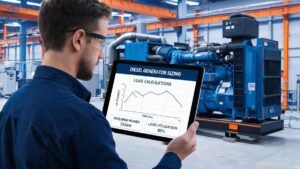
Step 2: Analyze Your Load Profile
- Variable load (motors, compressors, intermittent equipment): Prime power
- Fixed load (lighting, servers, constant process): Continuous or standby
- Occasional heavy spikes: Prime with 10% overload headroom
Step 3: Consider Future Expansion
If you might add equipment in 2-3 years, size up by 20-25% now. It’s cheaper to buy a slightly larger generator than to replace the whole unit later.
Common Mistakes We See
- Buying standby for prime use to save money. The “savings” disappear with the first major repair.
- Ignoring the average load rule for prime power. Running a 500kVA prime unit at 450kVA average will overheat the engine.
- Not accounting for altitude and temperature. A 500kVA generator at sea level is only ~400kVA at 3,000 meters. Derating applies to all ratings.
- Confusing kVA and kW. Generators are rated in kVA, but your equipment is in kW. At 0.8 power factor, 500kVA = 400kW.
The Bottom Line
Power rating isn’t a marketing label — it’s an engineering specification that determines how hard the engine can work and for how long. Choosing the wrong rating is the single most expensive mistake we see buyers make.
If you’re not sure which rating fits your project, reach out to us. At MechVolt Power, we ask the right questions upfront so you get a generator that matches your actual needs — not just your budget.
Need help sizing and rating a generator for your project? Contact our engineering team for a free consultation.