Why Getting the Generator Size Right Matters
At MechVolt Power, we’ve seen it happen hundreds of times — a buyer purchases a generator that’s too small and faces constant overloads, or invests in an oversized unit that wastes fuel and never runs efficiently. Getting the sizing wrong can cost you thousands of dollars in wasted investment, increased fuel consumption, and potential equipment damage.
The right generator size ensures reliable power delivery, optimal fuel efficiency, and longer equipment lifespan. In this guide, we’ll walk you through the entire process step by step, so you can make a confident, informed decision.
Step 1: Make a Complete Equipment List
Before you calculate anything, you need to know exactly what you’re powering. Start by listing every single electrical device that will run on the generator. Don’t forget the small items — they add up quickly.
Your list should include:
- Lighting — all bulbs, LED panels, and fixtures
- HVAC systems — air conditioners, heaters, ventilation fans
- Motor-driven equipment — pumps, compressors, conveyors
- Electronics — computers, servers, monitors, communication systems
- Kitchen appliances — refrigerators, freezers, microwaves (for site canteens)
- Safety systems — fire alarms, emergency lighting, security cameras
For each item, record three things: the running wattage (what it needs to operate), the starting wattage (the surge when it first turns on), and whether it runs continuously or intermittently.
Step 2: Understand Running vs. Starting Power
This is where most first-time buyers get confused. Every electrical device has two power ratings:
- Running (Rated) Power — The power needed to keep the device operating steadily. A 5-ton air conditioner might need 5,000W to run.
- Starting (Surge) Power — The brief spike in power when the device first turns on. That same 5-ton AC might need 12,000W to start — more than double its running power.
Motor-driven equipment and compressors typically have the highest starting surge — often 3 to 5 times their running wattage. Resistive loads like lighting and heating elements have little to no surge.
Motor Starting Multipliers
Use these multipliers when calculating starting power:
| Equipment Type | Starting Multiplier | Example |
|---|---|---|
| Lighting & Heating | 1.0x | 1,000W running = 1,000W starting |
| General Electronics | 1.2x | 500W running = 600W starting |
| Standard Motors | 2.0x | 2,000W running = 4,000W starting |
| Heavy Compressors | 3.0–5.0x | 3,000W running = 9,000–15,000W starting |
Step 3: Calculate Your Total Load
Now comes the math. You need to calculate two numbers:
1. Continuous Load — Add up the running wattage of all devices that will run simultaneously.
2. Peak (Surge) Load — Identify the single largest motor or compressor. Add its starting wattage to the running wattage of all other devices. This is your worst-case scenario — the moment when the biggest motor starts while everything else is already running.
Here’s a practical example for a small factory:
| Equipment | Running (kW) | Starting (kW) |
|---|---|---|
| Lighting (100 LED fixtures) | 5 | 5 |
| Air Compressor (30 HP) | 22 | 66 |
| Water Pump (10 HP) | 7.5 | 22.5 |
| Office Equipment | 3 | 3.6 |
| Security System | 0.5 | 0.6 |
| Canteen Refrigerator | 1.5 | 4.5 |
| Total Continuous | 39.5 | — |
| Peak Surge | — | 102.1 |
Step 4: Apply the Safety Margin
Never select a generator that exactly matches your calculated load. You need a safety margin for several reasons:
- Future expansion — You may add equipment later
- Altitude derating — Generators lose about 3% efficiency per 1,000 feet above sea level
- Temperature derating — High ambient temperatures reduce generator output
- Fuel quality — Poor fuel can reduce power output by 5–10%
We recommend a 20–25% safety margin for most applications. For critical facilities (hospitals, data centers), use 30–40%.
Using our factory example:
- Continuous load: 39.5 kW × 1.25 = 49.4 kW minimum
- Peak surge: 102.1 kW × 1.25 = 127.6 kW minimum
In this case, you’d need a generator rated for at least 150 kVA (approximately 120 kW at 0.8 power factor) to handle both continuous operation and peak starting surge.
Step 5: Choose Between Prime and Standby Rating
Generators are rated differently based on their intended use:
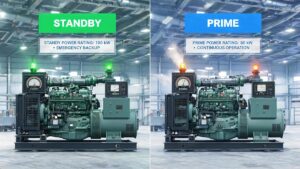
- Prime Power — For continuous use with a variable load. Can run 24/7 with a 10% overload for 1 hour every 12 hours. Ideal for mining, construction sites, and manufacturing.
- Standby Power — For emergency or backup use. Runs during power outages with no overload capacity. Typical for hospitals, office buildings, and data centers.
For most industrial and project applications, prime power rating is the right choice. It gives you the flexibility to run continuously and handle load variations.
Common Sizing Mistakes to Avoid
After helping hundreds of buyers size their generators, we’ve seen these mistakes repeatedly:
- Underestimating motor starting surge — Always use the manufacturer’s locked-rotor amps (LRA) for the most accurate starting power figure.
- Ignoring power factor — Generators are rated in kVA, but your load is in kW. Use a power factor of 0.8 for most industrial applications (kW = kVA × 0.8).
- Not considering altitude — A 500 kVA generator at sea level produces only about 400 kVA at 3,000 meters elevation.
- Adding all starting surges together — In reality, not all motors start at the same time. Calculate based on the single worst-case surge event.
- Forgetting about phase requirements — Three-phase power is standard for generators above 25 kW. Single-phase is only suitable for smaller residential units.
Quick Reference: Generator Size by Application
| Application | Typical Load Range | Recommended Generator Size |
|---|---|---|
| Small Retail Shop | 15–30 kW | 30–50 kVA |
| Office Building | 50–150 kW | 80–200 kVA |
| Restaurant / Hotel | 80–200 kW | 125–250 kVA |
| Small Factory | 100–300 kW | 150–400 kVA |
| Mining Operation | 200–1000+ kW | 300–1500 kVA |
| Hospital | 200–800 kW | 300–1000 kVA (standby) |
The Bottom Line
Sizing a diesel generator correctly isn’t complicated, but it requires careful attention to detail. List your equipment, calculate both running and starting power, apply a proper safety margin, and choose the right power rating for your application.
If you’re in the process of sizing a generator for your project and want a second opinion, feel free to reach out to us. At MechVolt Power, we provide free technical consultation — no sales pressure, just honest engineering advice. Our team has helped buyers in over 50 countries select the right generator for their specific needs.
Ready to find the right generator? Contact our engineering team today for a free load analysis and customized recommendation.