Why Fuel Consumption Matters More Than You Think
When buyers evaluate diesel generators, most focus on the purchase price and power output. But over a generator’s 10 to 15-year lifespan, fuel costs typically account for 70 to 80% of total operating expenses. Understanding how to calculate and manage fuel consumption is one of the most impactful decisions you can make for your project’s bottom line.
At MechVolt Power, we’ve helped hundreds of clients across Africa, Southeast Asia, and the Middle East optimize their generator fuel usage. In this guide, we’ll walk you through the formulas, factors, and practical strategies that matter most.
The Basic Formula: Specific Fuel Consumption (SFC)
The industry standard for measuring generator fuel efficiency is Specific Fuel Consumption (SFC), expressed in liters per kilowatt-hour (L/kWh) or gallons per kilowatt-hour (gal/kWh). Most diesel generators have an SFC between 0.25 and 0.40 L/kWh, depending on the engine brand, load level, and operating conditions.
The core calculation is straightforward:
Fuel Consumption (L/hr) = Rated Power (kW) × Load Factor × SFC
For example, a 500 kVA generator (approximately 400 kW at 0.8 power factor) running at 75% load with an SFC of 0.33 L/kWh would consume:
400 kW × 0.75 × 0.33 = 99 liters per hour
At an average diesel price of $1.10 per liter, that’s roughly $109 per hour of operation — or about $2,616 per day for continuous 24-hour running.
Understanding the Load Factor
The load factor is the ratio of actual power being used to the generator’s rated capacity. This is the single biggest variable affecting fuel consumption, and it’s where many operators make costly mistakes.
- 100% load: Maximum efficiency, lowest SFC — but not recommended for continuous operation due to engine wear.
- 75% load: The sweet spot for most diesel engines. Best balance of fuel efficiency and engine longevity.
- 50% load: Fuel efficiency drops by roughly 10-15% compared to 75% load.
- Below 30% load: Significantly inefficient. SFC can increase by 25-40%, and prolonged low-load operation causes engine damage known as “wet stacking.”
Last year, a client in Ghana was running a 1000 kVA generator at only 20% load for a small mining camp. By switching to a properly sized 250 kVA unit, they reduced their monthly fuel bill from $12,000 to $3,800 — a 68% savings.
Fuel Consumption by Generator Size: Quick Reference
Here’s a practical reference table based on typical SFC values at 75% load for common generator sizes we supply at MechVolt:
| Generator Size | Output (kW) | Fuel at 75% Load (L/hr) | Fuel at 100% Load (L/hr) | Est. Daily Cost (24hr, 75%) |
|---|---|---|---|---|
| 50 kVA | 40 kW | 9.9 L | 13.2 L | $261 |
| 100 kVA | 80 kW | 19.8 L | 26.4 L | $522 |
| 200 kVA | 160 kW | 39.6 L | 52.8 L | $1,045 |
| 500 kVA | 400 kW | 99.0 L | 132.0 L | $2,614 |
| 800 kVA | 640 kW | 158.4 L | 211.2 L | $4,181 |
| 1000 kVA | 800 kW | 198.0 L | 264.0 L | $5,227 |
Note: Calculations use SFC = 0.33 L/kWh and diesel price = $1.10/L. Actual values vary by engine brand and local fuel prices.
Key Factors That Affect Real-World Consumption
The formula above gives you a solid baseline, but real-world fuel consumption is influenced by several additional factors:
Engine Brand and Technology
Different engine manufacturers achieve different efficiency levels. In our experience working with Cummins, Perkins, Weichai, and Yuchai engines:
- Cummins engines tend to have the best fuel efficiency in the 200-800 kVA range, with SFC values around 0.28-0.32 L/kWh.
- Perkins engines offer excellent reliability with SFC around 0.30-0.34 L/kWh.
- Weichai engines provide the most competitive pricing with SFC around 0.32-0.36 L/kWh.
- Yuchai engines are popular in the smaller range (20-200 kVA) with SFC around 0.33-0.37 L/kWh.
Altitude and Temperature
Generators lose approximately 3% of their rated output for every 300 meters (1,000 feet) above sea level. At high altitudes, the engine has to work harder to produce the same power, increasing fuel consumption. Similarly, extreme temperatures — both hot and cold — reduce efficiency.
For a project in Nairobi (altitude ~1,700m), we typically recommend derating the generator by 15-18% and selecting a slightly larger unit to compensate.
Fuel Quality
Poor-quality diesel with high sulfur content or contamination reduces combustion efficiency and can increase fuel consumption by 5-10%. In regions where fuel quality is inconsistent, we recommend using fuel additives and regular fuel testing.
Maintenance Condition
A poorly maintained generator consumes significantly more fuel. Key maintenance items that directly affect fuel efficiency include:
- Air filter replacement: A clogged air filter can increase fuel consumption by 3-5%.
- Fuel filter replacement: Contaminated fuel filters restrict flow and reduce combustion efficiency.
- Injector calibration: Worn injectors cause poor fuel atomization, wasting fuel and reducing power output.
- Valve clearance adjustment: Incorrect valve clearance reduces compression and increases fuel use.
Practical Tips to Reduce Your Generator Running Costs
Based on our experience working with clients across different industries and regions, here are the most effective strategies:
1. Right-Size Your Generator
This is the single most impactful decision. A generator running at 50% load wastes fuel compared to one running at 75% load. Conduct a proper load analysis before purchasing, accounting for both steady-state and peak loads.
2. Use Automatic Mains Failure (AMF) Panels
AMF panels automatically start and stop the generator based on utility power availability, eliminating unnecessary idling. For sites with intermittent grid power, this can reduce generator runtime by 30-50%.
3. Implement Load Management
Stage your loads so the generator runs at optimal capacity. Instead of starting all equipment simultaneously, sequence non-critical loads to maintain a steady 70-80% load level.
4. Consider Parallel Operation for Variable Loads
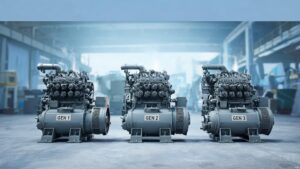
For sites with highly variable power demand, running two smaller generators in parallel can be more efficient than one large unit. Each generator can be brought online or taken offline as demand changes.
5. Schedule Preventive Maintenance
Regular maintenance not only extends engine life but also maintains optimal fuel efficiency. Follow the manufacturer’s service schedule and keep detailed maintenance records.
6. Monitor Fuel Consumption
Install fuel flow meters and track daily consumption. A sudden increase often indicates a developing problem — catching it early prevents costly repairs and excessive fuel waste.
Calculating Your Total Cost of Ownership
To make an informed purchasing decision, we recommend calculating the Total Cost of Ownership (TCO) over your expected operating period. Here’s a simplified example:
Scenario: 500 kVA generator running 12 hours per day at 75% load
- Generator purchase price: $45,000
- Annual fuel cost: 99 L/hr × 12 hr × 365 days × $1.10/L = $476,742/year
- Annual maintenance: ~$5,000/year
- 5-year TCO: $45,000 + ($476,742 + $5,000) × 5 = $2,428,710
As you can see, even a 5% improvement in fuel efficiency would save approximately $119,000 over 5 years — far more than the difference in purchase price between a standard and a premium engine option.
Need Help Sizing Your Generator?
Fuel consumption calculations depend on your specific load profile, site conditions, and operating hours. At MechVolt Power, we provide free load analysis and fuel consumption estimates for every project inquiry. Our engineers can help you select the right generator size and engine brand to minimize your total operating costs.
Contact our team today with your project details, and we’ll prepare a customized proposal with accurate fuel consumption projections and cost analysis for your specific application.