When you invest in a diesel generator set, whether it is a 100 kVA standby unit for a small office or a 2,000 kVA prime power system for a mining operation, one critical step stands between delivery and reliable operation: load bank testing. At MechVolt Power, we have seen projects where skipping this test led to expensive failures during the first real power outage. In this guide, we explain what load bank testing is, why it matters, and how to do it right.
What Is a Load Bank Test?
A load bank is a device that applies a controlled electrical load to a generator, simulating the real-world power demand the generator will face in operation. The test verifies that the generator can produce its rated output under load and that all systems — engine, alternator, cooling, fuel delivery, and controls — perform correctly together.
Think of it as the generator’s final exam before graduation. Without it, you are deploying a critical piece of equipment that has never been tested under real operating conditions.
Why Load Bank Testing Is Essential
1. Catches Factory Defects Before They Become Field Failures
Even top-tier manufacturers can ship a unit with a loose connection, a faulty sensor, or a cooling system issue. A load bank test at full rated output exposes these problems immediately. We have caught issues ranging from incorrectly torqued busbar connections to defective voltage regulators during routine load bank tests — all before the units left our facility.
2. Prevents Wet Stacking in Diesel Engines
Diesel generators that run at light loads for extended periods develop “wet stacking” — unburned fuel and carbon deposits that accumulate in the exhaust system and reduce engine efficiency. A full-load test burns off these deposits and restores engine performance. This is especially important for standby generators that may run at less than 30% load during weekly exercise cycles.
3. Verifies Cooling System Performance
A generator’s cooling system is designed to handle full-load heat rejection. Without a load bank, you cannot verify that the radiator, fan, and coolant circulation can maintain safe operating temperatures at maximum output. A unit that passes a no-load test may overheat and shut down within 15 minutes at full load.
4. Validates Voltage Regulation and Frequency Stability
The automatic voltage regulator (AVR) and governor must respond correctly to load changes. A load bank test with step-loading — applying load in increments of 25%, 50%, 75%, and 100% — confirms that voltage and frequency stay within acceptable limits at each step.
5. Supports Warranty Claims and Commissioning Documentation
Most generator manufacturers require a load bank test report as part of the commissioning documentation. If you ever need to make a warranty claim, having a documented test report showing the unit performed correctly at the time of commissioning is invaluable.
Types of Load Banks
| Type | How It Works | Best For |
|---|---|---|
| Resistive | Converts electrical energy to heat using resistor elements | Testing at unity power factor (1.0 PF); most common type |
| Reactive (Inductive) | Simulates inductive loads (motors, transformers) using inductors | Testing at lagging power factor (0.8 PF typical) |
| Combined Resistive/Reactive | Both resistive and inductive elements in one unit | Full capability testing at rated power factor |
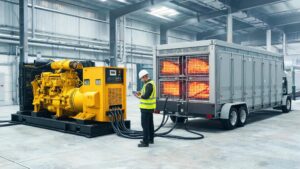
| Portable | Trailer-mounted or skid-mounted for easy transport | Field commissioning and periodic testing |
| Permanent | Fixed installation at the generator site | Regular testing of critical standby generators |
Load Bank Testing Procedure: Step by Step
Pre-Test Preparation
- Review the generator specifications: Confirm rated kVA/kW, voltage, frequency, power factor, and maximum ambient temperature rating.
- Verify load bank capacity: The load bank must be rated for at least 100% of the generator’s rated output. For a 500 kVA generator, you need a 500 kW (or larger) resistive load bank.
- Check cable sizing: Load bank cables must be sized correctly for the test current and voltage drop. Undersized cables can cause voltage drop that skews test results.
- Ensure adequate ventilation: The test area must have sufficient airflow to dissipate the heat generated by the load bank. A 500 kW resistive load bank produces approximately 500 kW of heat — equivalent to about 170 electric space heaters running simultaneously.
- Prepare instrumentation: Calibrate or verify all measurement instruments — voltmeter, ammeter, frequency meter, temperature sensors, and data logging equipment.
Test Execution
- Start the generator and allow it to reach stable operating temperature (typically 5-10 minutes at no load).
- Apply load in steps: 25% → 50% → 75% → 100% of rated output. Hold each step for at least 15-30 minutes to allow temperatures to stabilize.
- Record data at each step: Voltage (all phases), current (all phases), frequency, engine speed, coolant temperature, oil pressure, exhaust temperature, and ambient temperature.
- Hold at 100% load: Maintain full rated load for a minimum of 2 hours, or longer if specified by the project requirements. For critical applications, a 4-hour full-load test is common.
- Step down: Reduce load in reverse steps (75% → 50% → 25% → 0%) and verify that voltage and frequency recover correctly at each step.
- Cool down: Run the generator at no load for 5-10 minutes to allow controlled cooling before shutdown.
Acceptance Criteria
| Parameter | Acceptable Range |
|---|---|
| Voltage regulation | ±2.5% of rated voltage at steady state |
| Frequency regulation | ±2% of rated frequency at steady state |
| Coolant temperature | Below manufacturer’s maximum (typically 95-105°C) |
| Oil pressure | Within manufacturer’s specified range at all loads |
| Exhaust temperature | Below maximum rated exhaust temperature |
| Voltage/frequency transient response | Recovers within 2-5 seconds after load step |
Common Mistakes to Avoid
- Skipping the test entirely: The most expensive mistake. A generator that fails during a real outage costs far more than the test itself.
- Testing at partial load only: A generator that runs fine at 50% load may have problems at 100% load. Always test up to the rated output.
- Inadequate cooling during the test: Load banks generate enormous heat. Testing in a confined space without proper ventilation can cause the load bank to overheat and trip, or worse, create a fire hazard.
- Not recording data: “It looked fine” is not a commissioning report. Document every parameter at every load step. This data is your proof of performance and your baseline for future maintenance comparisons.
- Ignoring ambient conditions: A generator rated at 40°C ambient will produce less power at 50°C. If you are testing in hot conditions, apply the manufacturer’s derating factors to your acceptance criteria.
When to Perform Load Bank Testing
| Scenario | Recommended Test |
|---|---|
| Factory acceptance testing (FAT) | Full load test at manufacturer’s facility before shipment |
| Site commissioning | Full load test after installation, before handover |
| Annual maintenance | Minimum 1-hour test at 80%+ load |
| After major repairs | Full load test before returning to service |
| After extended storage | Full load test to verify all systems |
Final Thoughts from MechVolt Power
At MechVolt Power, load bank testing is a standard part of our factory acceptance testing for every generator set we manufacture. We test every unit at 100% rated load before it leaves our facility, and we provide a detailed test report with all recorded parameters. For projects where we handle site commissioning, we bring portable load banks and perform the full commissioning test on-site.
If you are purchasing a generator set, ask your supplier about their load bank testing procedures. A supplier who cannot or will not provide a full-load test report should raise a red flag. The cost of a load bank test is a fraction of the cost of a generator failure during a critical power outage.
Need help with generator testing and commissioning? Contact our engineering team. We can advise on test procedures, recommend load bank specifications, or provide on-site commissioning support for your project.
Related reading: Cummins vs Perkins vs Weichai: A Fair Comparison of Popular Generator Engines | How to Choose the Right kVA for Your Factory