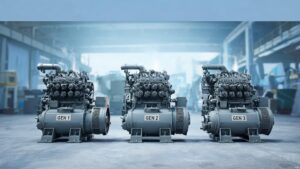
Introduction to Generator Parallel Operation
Parallel operation — also known as paralleling or synchronized operation — is the practice of connecting two or more diesel generators to work together to supply a common electrical load. This technique is widely used in industrial facilities, data centers, hospitals, and large commercial buildings where power demands are high and reliability is critical.
In a parallel system, the combined output of multiple generators can be synchronized so that they behave as a single, larger power source. When done correctly, parallel operation provides significant advantages in terms of redundancy, scalability, flexibility, and fuel efficiency.
Key Benefits of Parallel Operation
1. Redundancy and Reliability
An N+1 parallel configuration ensures that if one generator fails or requires maintenance, the remaining units can continue to supply the full load without interruption. This is essential for mission-critical applications such as data centers, hospitals, and telecommunications facilities where even a brief power outage is unacceptable.
2. Scalability and Capacity Expansion
Instead of investing in a single very large generator, you can start with smaller units and add more as your power demand grows. This approach reduces initial capital expenditure and allows you to match your power capacity to your actual needs at each stage of development.
3. Maintenance Flexibility
In a parallel system, individual generators can be taken offline for routine maintenance without disrupting the power supply. This ensures that your maintenance schedule never compromises your operational reliability.
4. Improved Fuel Efficiency
When load demand is low, you can operate only the minimum number of generators needed, running each at or near its optimal load point (typically 70-80% of rated capacity). This reduces fuel consumption, extends engine life, and minimizes emissions compared to running a single large generator at partial load.
Fundamental Conditions for Parallel Operation
For diesel generators to operate in parallel safely and effectively, the following conditions must be met:
- Equal Voltage: All generators must produce the same voltage level (both magnitude and waveform).
- Equal Frequency: The frequency of each generator’s output must be identical. This is typically 50 Hz or 60 Hz, depending on your region.
- Same Phase Sequence: The phase rotation (L1-L2-L3) must be identical across all generators. Incorrect phase sequence will cause catastrophic failure.
- Phase Angle Synchronization: The voltage waveforms of all generators must reach their peaks and zero crossings at the same instant. A dedicated synchronizer or governor control adjusts the frequency slightly to achieve this alignment before the circuit breaker closes.
- Proportional Load Sharing: Each generator must share the total load in proportion to its rated capacity. This requires compatible governors for active power (kW) sharing and automatic voltage regulators (AVRs) for reactive power (kVAR) sharing.
Types of Parallel Control Systems
1. Manual Synchronization
In manual paralleling, a skilled operator uses a synchroscope and frequency/voltage meters to adjust the incoming generator’s speed and voltage until it matches the bus. The operator then closes the generator circuit breaker at the precise moment of synchronization. While this is the lowest-cost option, it requires highly trained personnel and carries a higher risk of operator error. Manual synchronization is generally only recommended for emergency backup systems.
2. Automatic Synchronization
Automatic synchronizers (such as the Deep Sea Electronics DSE8610 or ComAp InteliGen) handle the entire paralleling process without human intervention. The controller adjusts the governor and AVR of the incoming generator, monitors synchronization parameters, and closes the breaker only when all conditions are within acceptable tolerances. Automatic synchronization is the standard choice for most commercial and industrial parallel installations.
3. Intelligent Load Sharing with PLC/SCADA
For complex multi-generator installations, a centralized PLC or SCADA system can manage the entire parallel system, including automatic start/stop sequences, optimal generator selection based on load demand, predictive maintenance scheduling, and remote monitoring. These systems offer the highest level of control and are commonly used in large data centers, mining operations, and utility-scale power plants.
Installation Best Practices
Generator Selection
- Use generators with identical or very similar ratings and characteristics whenever possible. Mismatched generators can lead to unstable load sharing and circulating currents.
- Ensure all generators are equipped with compatible governors (isochronous or droop) and AVRs that support parallel operation.
- Verify that each generator’s engine and alternator are rated for continuous parallel duty.
Electrical Considerations
- Use properly sized busbars and cabling to handle the combined fault current of all parallel generators.
- Install individual circuit breakers for each generator with appropriate protection settings (overcurrent, reverse power, earth fault).
- Ensure the busbar is rated for the total potential fault current, which increases with each additional generator in parallel.
- Implement proper grounding and earthing for the entire parallel system.
Mechanical and Environmental Factors
- Provide adequate ventilation and cooling for the generator room, as multiple running generators generate significant heat.
- Ensure fuel supply systems can deliver sufficient fuel to all generators at full load simultaneously.
- Design exhaust systems to prevent back-pressure interference between generators.
- Consider vibration isolation for each generator set to prevent structural resonance issues.
Common Troubleshooting Issues
Circulating Current Between Generators
Symptom: Generators exhibit unequal reactive power sharing, with one generator supplying more kVAR than the others. This can cause overheating in the alternator windings.
Cause: Mismatched AVR settings or voltage droop characteristics.
Solution: Recalibrate all AVRs to identical voltage setpoints and droop settings. Check cross-current compensation wiring and adjust as needed.
Unstable Power (Hunting or Surging)
Symptom: The system frequency or voltage oscillates, and generators may repeatedly pick up and drop load.
Cause: Governor instability, fuel system issues, or incorrect droop settings.
Solution: Verify governor stability settings. Ensure fuel lines are free of air bubbles and restrictions. Check that droop settings are consistent across all generators (typically 3-5% for parallel operation).
Reverse Power Trip
Symptom: A generator circuit breaker trips on reverse power protection, causing the affected generator to shut down.
Cause: One generator is acting as a motor, drawing power from the bus instead of supplying it. This usually indicates a governor or fuel system problem, or an imbalance in active power sharing.
Solution: Inspect the governor and fuel injection system of the affected generator. Recalibrate the governor to ensure proper kW sharing.
Difficulty Synchronizing
Symptom: The synchronizer fails to close the breaker, or synchronization takes excessively long.
Cause: Incorrect phase sequence, large voltage or frequency mismatch, or faulty synchroscope/synchronizer.
Solution: Verify phase sequence with a phase rotation meter before attempting to parallel. Check that voltage and frequency are within synchronization tolerances (typically ±0.5% voltage, ±0.1 Hz frequency). Test the synchronizer with known-good equipment.
Conclusion
Parallel operation of diesel generators is a powerful technique that provides scalability, redundancy, and efficiency for critical power applications. However, successful paralleling requires careful planning, proper equipment selection, and meticulous installation. By following the guidelines and best practices outlined in this article, you can ensure that your parallel generator system operates reliably and efficiently for years to come.
If you are considering a parallel generator installation for your facility, MechVolt Power’s engineering team can provide comprehensive design consultation, equipment selection, and commissioning support. Contact us to discuss your specific power requirements.