Why Enclosure Type Matters
When buyers compare diesel generator quotations, the engine brand and rated power usually receive the most attention. The enclosure type often looks like a secondary detail, but it can decide how smoothly the project is installed, how much civil work is needed, and how reliable the generator remains after years of dust, rain, heat, and daily operation.
At MechVolt Power, we normally discuss enclosure design early in the project because a generator set is not used in a showroom. It operates in mines, factories, hospitals, telecom sites, ports, farms, and construction camps where weather, sound limits, transport routes, and service access all matter. The right choice is not always the most expensive option. It is the configuration that fits the site, the duty cycle, and the budget.
The Basic Difference
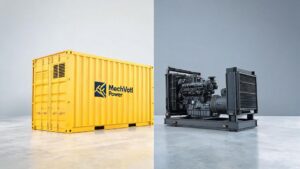
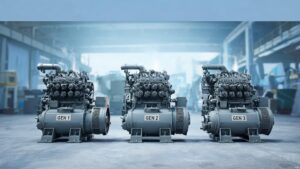
An open-frame generator set uses a skid-mounted structure without a full weatherproof canopy. The engine, alternator, radiator, exhaust system, and control panel remain easy to see and service. It is often installed inside a dedicated generator room or power house where the building provides protection and ventilation.
A containerized generator set places the equipment inside a steel container or container-style acoustic enclosure. The package can include sound insulation, ventilation louvers, fuel tanks, lighting, fire protection interfaces, cable outlets, and walk-in service space. For many remote or outdoor projects, the container becomes a compact power station instead of only a protective shell.
Cost Comparison
For the same engine and alternator, an open-frame generator typically has the lowest initial price. There is less steel, fewer acoustic materials, and fewer customized structural parts. For indoor installations where a generator room already exists, an open-frame design can be the most economical and practical solution.
A containerized set costs more at the equipment stage, but the total project cost may be lower if it reduces civil works, shortens installation time, or avoids the need to build a dedicated generator house. For example, one mining client in West Africa originally planned a masonry generator room for a 500kW unit. After comparing construction cost, ventilation design, and schedule risk, they selected a containerized package and saved nearly three weeks on site preparation.
| Factor | Open-Frame Set | Containerized Set |
|---|---|---|
| Initial equipment price | Lower | Higher |
| Outdoor protection | Requires building or canopy | Built into the package |
| Noise control | Depends on room design | Can be engineered into enclosure |
| Installation speed | Fast if room is ready | Fast for remote outdoor sites |
| Long-distance relocation | Less convenient | Better suited for relocation |
Weather and Environmental Protection
Open-frame units perform well when installed indoors with correct ventilation and clean airflow. They are not designed to sit directly in heavy rain, sandstorms, salt mist, or extreme sun exposure without additional protection. If the site is near the coast, in a desert region, or close to industrial dust sources, the generator room design becomes especially important.
Containerized generators are better suited for harsh outdoor conditions. A properly designed container includes weatherproof louvers, drainage, anti-corrosion coating, access doors, vibration isolation, and protected cable entry points. For projects in humid tropical climates, we often recommend anti-condensation heaters for the alternator and upgraded coating for the enclosure.
Noise Control
Noise requirements vary widely by application. A quarry or remote mining camp may accept a higher sound level, while a hospital, residential development, or hotel project may require strict acoustic performance. An open-frame set can be quiet if the generator room includes silencers, acoustic panels, and proper air intake and exhaust treatment, but this depends heavily on building design.
A containerized set allows the acoustic system to be engineered as part of the generator package. Typical silent container designs can reduce noise to around 75 dB(A) at 7 meters, depending on generator size and airflow requirements. For very sensitive locations, additional residential-grade silencers and larger ventilation channels may be required.
Maintenance Access
Open-frame generators are easy to inspect because all major components are visible. Mechanics can access filters, belts, injectors, hoses, alternator terminals, and radiator connections without opening multiple doors. This is a strong advantage for indoor power stations with trained maintenance teams.
Containerized systems need careful layout planning. A low-cost container with poor service space can make routine maintenance frustrating. At MechVolt Power, we normally reserve walk-in access for larger sets, place service points on the door side, and confirm that filters, oil drains, battery racks, and control panels can be reached safely.
Mobility and Project Flexibility
If the generator will stay in one factory for 10 years, mobility may not matter. If the equipment will move between construction sites, drilling areas, temporary camps, or seasonal operations, a containerized package can be much easier to transport and redeploy. Lifting points, forklift pockets, internal fuel tanks, and protected controls reduce the chance of damage during relocation.
Open-frame units can also be moved, but they usually need additional packaging or careful handling. Exposed radiators, wiring, exhaust pipes, and control panels are more vulnerable during transport.
When to Choose Open-Frame
An open-frame diesel generator is usually the better choice when the site already has a well-designed generator room, when purchase budget is tight, when maintenance access is a priority, or when the installation is permanent and indoors. It is also a good fit for factories where noise can be controlled through building-level acoustic design.
When to Choose Containerized
A containerized generator set is usually the better choice for remote outdoor sites, mining projects, construction camps, telecom power stations, emergency standby systems, and locations with strict noise or weather requirements. It is also useful when the buyer wants a more complete turnkey package that can be installed quickly with less site construction.
How We Help Buyers Decide
Before recommending an enclosure type, we ask clients about site location, installation environment, load profile, noise limit, transport route, maintenance capability, and expansion plans. A 200kVA standby generator for an indoor factory and a 1000kVA prime power system for a desert mining camp should not use the same enclosure logic.
If you are comparing generator quotations and the enclosure options are unclear, send our team your site photos, load list, and installation requirements. We can help you compare open-frame, silent canopy, and containerized generator configurations based on real project conditions.