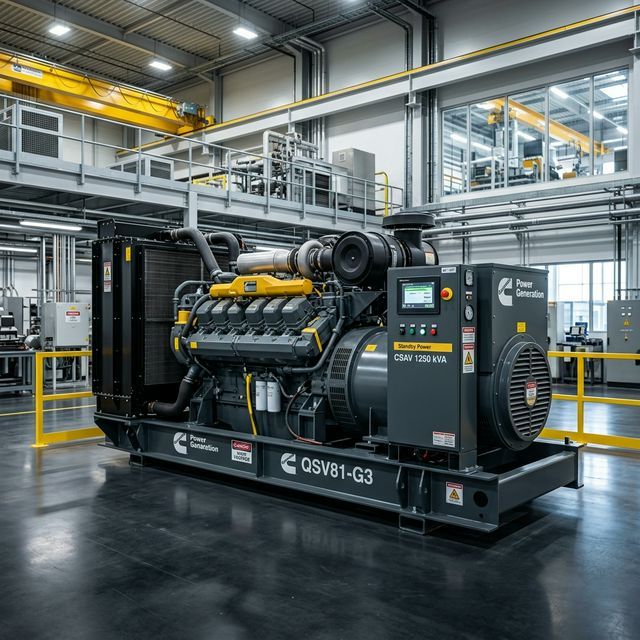
Understanding Your Power Requirements
Determining the correct size for a diesel generator is the most critical step in ensuring reliable backup or prime power for your facility. An undersized generator will struggle to handle the load, leading to voltage drops, equipment damage, and potential generator failure. Conversely, an oversized generator represents unnecessary capital expenditure and can suffer from “wet stacking” if run consistently below its optimal load capacity.
1. Calculate Your Total Wattage
The first step is to compile a comprehensive list of all the electrical equipment, appliances, and machinery the generator needs to power simultaneously. You must account for two types of wattage:
- Running Watts (Rated Watts): The continuous power required to keep your equipment running.
- Starting Watts (Surge Watts): The extra burst of power required to start electric motors (such as those in HVAC systems, large compressors, or heavy industrial machinery). Starting watts can be 2 to 3 times higher than running watts.
Your generator must be sized to handle the peak starting wattage of your largest motors, combined with the running wattage of all other connected loads.
2. Single-Phase vs. Three-Phase Power
You must select a generator that matches your electrical service:
- Single-Phase (120/240V): Typically used for residential, agricultural, and light commercial applications.
- Three-Phase (120/208V, 277/480V, etc.): Essential for industrial applications, data centers, and large commercial facilities operating heavy machinery with three-phase motors.
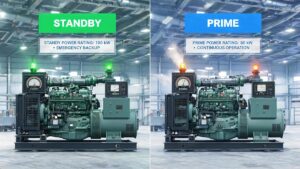
3. Prime vs. Standby Ratings
Diesel generators come with different power ratings based on their intended application:
- Standby Power: Designed to provide emergency power for the duration of a utility outage. They are not intended to run 24/7 at 100% capacity.
- Prime Power: Designed for continuous operation where there is no utility grid (e.g., remote construction sites or mining operations). Prime power generators are built to run for extended periods at a variable load.
4. The 80% Rule
As a professional rule of thumb, it is highly recommended to size your generator so that your maximum expected load sits at around 70% to 80% of the generator’s total capacity. This 20-30% margin of safety accommodates future expansion, prevents the generator from operating at its absolute limit, and extends the lifespan of the engine and alternator.
Consult a Professional
While calculating your load is a great starting point, sizing an industrial diesel generator involves complex factors including voltage dips, harmonic distortion, and environmental conditions (altitude and temperature derating). We strongly advise consulting with our technical experts at MechVolt Power to conduct a thorough load analysis and ensure you select the perfect generator set for your specific application.